
Best Quilting Fabrics for Beginners: Top Picks
Table of Contents
- Best Quilting Fabrics for Beginners: Quick Comparison
- How to Choose Quilting Fabric Without the Guesswork
- Precut Quilting Fabric for Beginners: Bundles, Charm Squares, and Fat Quarters
- Which Fabrics to Avoid or Use Cautiously
- Easy Quilt Patterns for Beginners: Match Fabric to Project
- How Much Fabric to Buy for Your First Quilt
- Conclusion: Start With One Good Cotton Bundle
- Frequently Asked Questions
Last Updated: October 9, 2026
Best Quilting Fabrics for Beginners: Quick Comparison
The best quilting fabrics for beginners are 100% cotton in a quilter's weight, and the difference between a frustrating first quilt and a finished one usually comes down to fabric choice. At The Wandering Quilt Shop, we stock pre-cut cotton bundles and kits because beginners do better when the fabric arrives ready to sew. Below, we compare our beginner-friendly options and how to choose quilting fabric without the guesswork.
Quick Picks:
- Best Overall: The Mouse & The Peacock six half-yard cuts ($44.00), premium cotton, generous size, gift-boxed
- Best Precut Bundle: Tilda Creating Memories fat quarter bundles ($78.90), 16 coordinated 100% cotton pieces
- Best Budget Start: Alice Caroline Liberty Tana Lawn charm squares ($19.00), 36 pieces, small commitment
- Best Guided Project: Liberty Tana Lawn Mini Sampler Quilt Kit ($73.00), fabric and instructions in one box
| Option | What You Get | Price | Best For |
|---|---|---|---|
| Mouse & The Peacock half-yard box | 6 half-yard cuts, premium cotton | $44.00 | First full-size quilt |
| Tilda Creating Memories FQB | 16 fat quarters, 100% cotton | $78.90 | Coordinated color palettes |
| Liberty charm squares (2.5") | 36 squares, mixed colors | $19.00 | Small practice projects |
| Liberty charm squares (5") | 20 squares, mixed colors | $29.00 | Charm-pack patterns |
| Liberty Mini Sampler Quilt Kit | Fabric plus illustrated instructions | $73.00 | A guided first quilt |
How to Choose Quilting Fabric Without the Guesswork
Choosing quilting fabric for a first quilt means weighing three properties: weight, weave, and stability. Quilting cotton is woven, usually around 4 to 4.5 ounces per square yard, with a tight plain weave that holds a crease and resists stretching, so it cuts cleanly, feeds evenly, and presses flat.

Weigh the three properties that matter: weight, weave, and stability
Fabric weight determines how the quilt drapes and how easily your machine handles it.
Weave matters because a tight weave keeps fraying to a minimum; loose, open weaves shed threads along every cut edge.
Stability is the quiet hero.
For a deeper look at how fabric structure affects sewing, the Fabric University guide to woven fabric construction explains weave and grain in plain terms.
Precut Quilting Fabric for Beginners: Bundles, Charm Squares, and Fat Quarters
Precut quilting fabric for beginners removes the two hardest steps: choosing coordinating prints and cutting accurate squares.
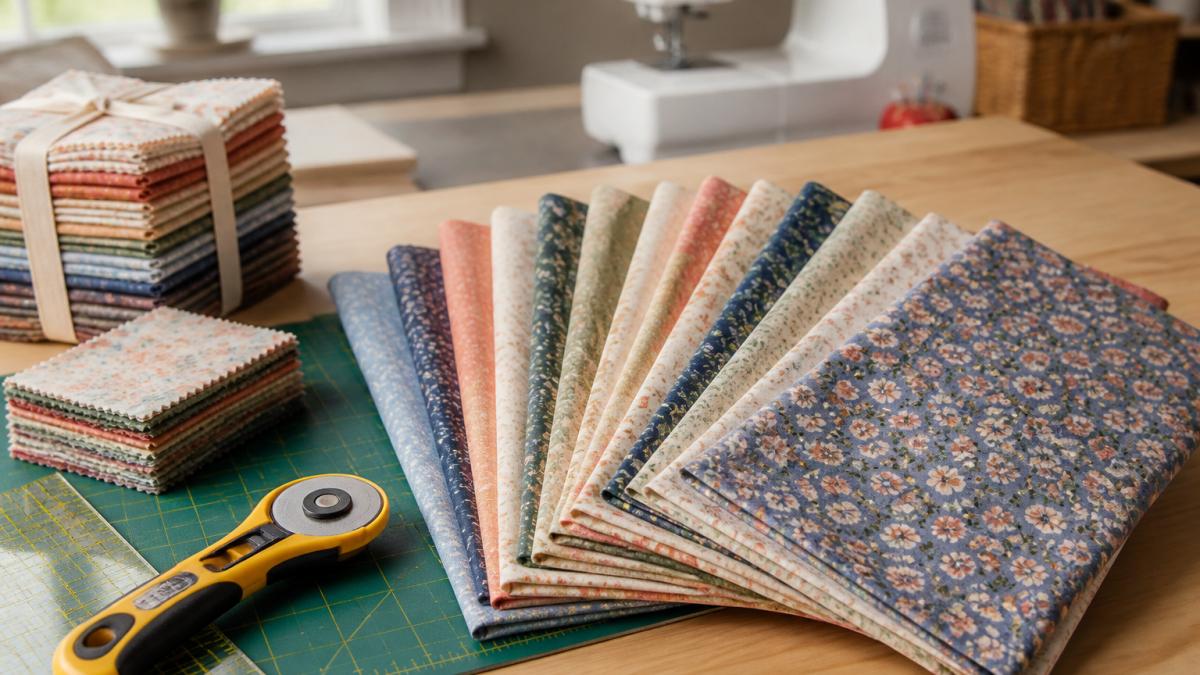
The Tilda Creating Memories fat quarter bundle shows why bundles work: 16 pieces of 100% cotton prints and wovens, double-folded so you see every fabric at a glance.

If a full bundle feels like too much commitment, charm squares are the low-risk entry. The 2.5-inch Liberty Tana Lawn set gives you 36 fabrics for $19.00, and the 5-inch set gives you 20 for $29.00.
Which Fabrics to Avoid or Use Cautiously
Avoid stretchy, slippery, or loosely woven fabrics for a first quilt, because they punish every beginner skill at once.
The reason these fabrics fail is mechanical, not aesthetic. A sewing machine feeds fabric by pinching it between the presser foot and the feed dogs, then advancing it one stitch at a time.
Fabrics that need caution rather than outright avoidance:
- Flannel: soft and warm, but it sheds lint into your machine and can stretch on the crosswise grain. Prewash it to shrink and tighten the weave, then consider it for backing or a whole-cloth quilt rather than intricate piecing. If you piece with flannel, use a shorter stitch length and a walking foot.
- Linen: beautiful drape and texture, but it wrinkles aggressively and frays more than cotton. A linen-cotton blend behaves closer to quilting cotton and is the safer entry point. With pure linen, starch before cutting and handle cut pieces gently.
- Minky and cuddle fabric: wonderful for a baby quilt backing, nearly impossible to piece because the pile hides your seam allowance and the fabric creeps under the needle. Use it on the back only, and baste heavily.
- Liberty Tana Lawn: a fine, tightly woven cotton lawn that sews beautifully but has a lighter hand than standard quilting cotton. It suits small, precise projects rather than a heavy bed quilt, where the weight pulls on lighter seams.
- Batting-adjacent fabrics: fleece and felt have no grain and no stability, so they stretch in every direction. They work as a backing in a pinch but not as a piecing fabric.
What most guides miss is that "avoid" is usually about the project, not the fabric. Minky is a poor quilt top and an excellent backing.

Troubleshooting the fabrics you already bought
If you have already cut into a difficult fabric, most problems have a workaround:
- Fraying: finish cut edges with a zigzag stitch or a serger before piecing, or apply a light starch and press the edges before cutting.
- Stretching: stay-stitch the edges within a quarter inch of the cut line, and handle pieces by the center rather than the corners.
- Slippery fabric: pin generously, lower your stitch speed, and consider a walking foot to feed top and bottom layers together.
- Uneven feeding: clean the feed dogs, replace a dull needle, and reduce presser foot pressure if your machine allows it.
- Color bleeding: test a scrap in warm water before washing the finished quilt, and use a color catcher sheet the first time you wash it.
None of these fixes make a difficult fabric easy, only survivable. For a first quilt, save the challenging fabric for later and start with cotton that cooperates.
The Mouse & The Peacock - 6 (1/2 YD CUTS) OF PREMIUM COTTON FABRIC NESTLED →
Easy Quilt Patterns for Beginners: Match Fabric to Project
Easy quilt patterns for beginners work best when the fabric matches the project's demands. A simple patchwork quilt made from charm squares asks for stable quilting cotton.
For a first quilt, we would point you toward a pattern built on one precut size.
If you would rather have fabric and instructions arrive together, the Liberty Tana Lawn Mini Sampler Quilt Kit ($73.00) includes the fabric and fully illustrated instructions, and finishes at 17.5 by 17.5 inches.
How Much Fabric to Buy for Your First Quilt
Buy one precut bundle plus background, binding, and backing fabric for your first quilt, rather than calculating yardage from scratch. Precuts are sold in standard sizes, and pattern books list requirements in those same units, so the math is already done.
Here is a worked example for a simple lap quilt, roughly 50 by 60 inches, built from one charm pack:
- Main patchwork: one charm pack (42 squares, 5 inches each) covers a quilt top of about 35 by 42 inches sewn into a grid. For a larger top, buy two charm packs or one fat quarter bundle.
- Background fabric: 1.5 to 2 yards of quilting cotton. This is the fabric between your charm squares, and it is what makes the pattern read. Buy 2 yards if you are unsure.
- Binding: 1/2 yard yields about 200 inches of 2.5-inch binding strips, enough for a 50 by 60 inch quilt with a few inches to spare. For a larger quilt, buy 3/4 yard.
- Backing: 3.5 yards of 44-inch-wide quilting cotton, or 2 yards of 108-inch-wide backing fabric. The backing must be at least 4 inches larger than the quilt top on every side for quilting take-up.
- Batting: one crib-size package (45 by 60 inches) for a small lap quilt, or a twin-size package (72 by 90 inches) for anything larger. Batting must extend at least 2 inches beyond the quilt top on every side.
That is the entire shopping list for a first project: one charm pack, 2 yards background, 1/2 yard binding, 3.5 yards backing, and one batting package.
A quick yardage rule of thumb
If you would rather not work through a pattern's chart, use this approximation for a simple patchwork quilt:
- Quilt top: total square inches of the finished top, divided by 1,440 (the usable square inches in a yard of 40-inch-wide fabric), gives you yards needed. Add 15 percent for cutting waste.
- Backing: quilt width plus 8 inches, by quilt length plus 8 inches, then convert to yards based on your backing width.
- Binding: perimeter of the quilt plus 12 inches, divided by 40, gives you the number of 2.5-inch strips. Multiply strips by 2.5 inches and divide by 36 to get yards.
These formulas are not a substitute for a pattern's requirements, but they let you sanity-check a shopping list before you shop.
Conclusion: Start With One Good Cotton Bundle
The hardest part of a first quilt is committing to fabric you will still like after forty hours of piecing. One good 100% cotton bundle solves that: coordinated prints, stable quilter's-weight fabric, no yardage math.
That is the whole idea behind The Wandering Quilt Shop.
Subscribe to our emails to hear where the Airstream is headed next, and we will have your first bundle waiting.
Frequently Asked Questions
What is the best fabric for quilting for beginners?
Quilting cotton at quilter's weight is the easiest starting point. It is 100% cotton, holds a crisp press, and does not shift under the needle the way slippery or stretchy fabrics do. Quilter's-weight cotton typically runs about 4 to 4.5 ounces per square yard, which is heavy enough to feed evenly through a sewing machine and light enough to hand-piece. Precut bundles like the Tilda Creating Memories fat quarter bundles ($78.90 for 16 pieces of 20x22in) remove the measuring step entirely, so you can start piecing the day your fabric arrives.
Are precut fabrics good for beginner quilters?
Yes, and they solve the most common beginner problem: uneven cutting. Charm squares, fat quarters, and half-yard cuts arrive pre-squared, so your seam allowance stays consistent from the first patchwork block to the last. The Alice Caroline Liberty Tana Lawn 2.5in charm squares ($19.00 for 36 pieces) suit small patchwork projects, while the 5in squares ($29.00 for 20 pieces) work for larger blocks.
How much fabric do I need for my first quilt?
A baby quilt usually needs about 3 to 4 yards of total fabric across the quilt top, plus backing and binding. A throw quilt runs closer to 6 to 8 yards. The simplest way to avoid math errors is to buy a fat quarter bundle and pair it with a pattern written for that bundle. Fat Quarters By The Dozen ($24.95) lists twelve quilts, each built from twelve fat quarters plus background and binding, so the yardage is spelled out before you cut anything.
Is 100% cotton the best fabric for quilting?
For most beginner projects, yes. Cotton presses flat, keeps a sharp crease for piecing, and frays less than linen or flannel during cutting. It also survives repeated washing without pilling. Flannel and minky are softer but stretch and shed, which makes them better for quilt backing than for the quilt top. Liberty Tana Lawn, a fine 100% cotton lawn, is an exception worth trying once your seams are steady, because it is lighter and drapes more than standard quilting cotton.
What is the 60-30-10 rule for quilting?
The 60-30-10 rule is a color-balance guideline: 60 percent of your fabric should be a dominant color, 30 percent a secondary color, and 10 percent an accent. It keeps a quilt top from looking flat or chaotic. A fat quarter bundle with a built-in color theme, such as the Tilda Creating Memories Autumn bundle in ginger, saffron, brown, and rust, already follows this distribution, so you can piece without second-guessing which print belongs where.